How lessons work
- Short lessons in a steady rhythm: a quick review, something new, practice, then a one-question check.
- Practice is marked as you go, with hints that arrive one tap at a time and never give the answer early.
- Lessons that were hard come back later for spaced review, so learning sticks.
- Kindergarten and Grade 1 lessons are read aloud, with songs and answers a child can say out loud.
- From Grade 2 up, lessons come with illustrations, a short lesson video and a Listen button that reads each step aloud.
- Parent reports show what was learned, what to revisit and the hours spent, and you keep the records.
Inside a lesson
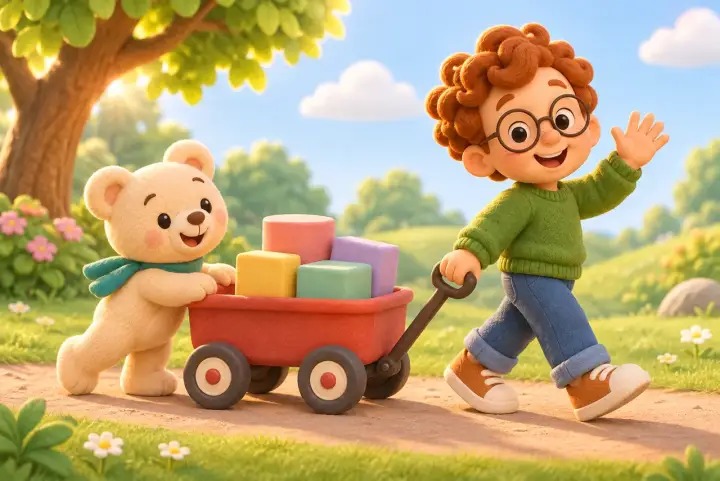
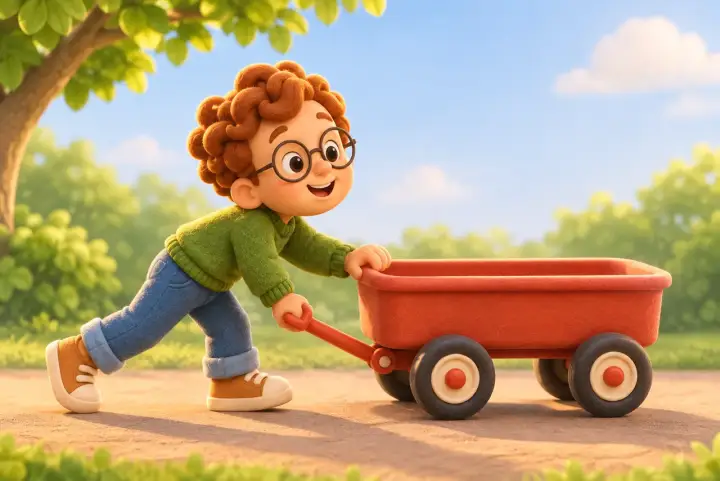
Every lesson comes with pictures, a short narrated-picture video and Listen read-aloud. Here are the pictures and Listen audio from one real lesson.
Forces are pushes and pulls
Listen
Ayo pulls a wagon while Lin pushes it from behind. How many forces are acting on the wagon?
Grade 3 English language arts: units and lessons
Grade 3 English Language Arts
English language arts · 8 units · 115 lessons · about 71 hours
Aligned to 90 Common Core English language arts standards.
- Stories and characters: friends and families (16 lessons). Close reading of stories: details, theme and character; narrative writing.
- Reading to learn: animals and habitats (16 lessons). Main ideas, evidence and explanations in nonfiction; informative writing; word strategies.
- How authors write stories: fables and folktales (14 lessons). Word choice, structure and point of view in stories; planning and revising writing.
- How nonfiction is built: how things are made (14 lessons). Text structure and features in nonfiction; short research with notes and sources.
- Making a case: our community (14 lessons). Opinion and argument: reasons, evidence and listening to other views.
- Poems, plays and pictures: poems that play with sound (14 lessons). Poetry, drama and visual media; comparing a text with its audio or film version.
- Texts in conversation: two tellings of one tale (14 lessons). Comparing texts on one theme or topic; presenting findings; writing with technology.
- Reading life and writing portfolio: my reading year (13 lessons). Independent reading at grade level, writing over time, and a portfolio of best work.
Grade 3 math: units and lessons
Grade 3 Mathematics
Math · 11 units · 120 lessons · about 75 hours
Aligned to 37 Common Core math standards.
- What multiplication means (12 lessons). Equal groups, arrays and unknown-factor problems.
- What division means (10 lessons). Sharing and grouping; division as an unknown-factor problem.
- Place value, rounding and add/subtract to 1,000 (10 lessons). Rounding, fluency within 1,000, and multiples of 10.
- Properties and fact fluency (12 lessons). Commutative, associative and distributive properties; facts to 100.
- Area (12 lessons). Unit squares, tiling and area with multiplication and addition.
- Fractions as numbers (12 lessons). Unit fractions and fractions on a number line.
- Equivalent and comparing fractions (12 lessons). Equal fractions, whole numbers as fractions, comparing with reasoning.
- Time, liquid volume and mass (10 lessons). Time to the minute and elapsed time; grams, kilograms and liters.
- Data (10 lessons). Scaled picture and bar graphs; line plots with halves and quarters.
- Two-step problems and patterns (10 lessons). Four operations in two-step problems; arithmetic patterns.
- Perimeter and shapes (10 lessons). Perimeter, shape categories and partitioning shapes.
Grade 3 science: units and lessons
Grade 3 Science
Science · 7 units · 45 lessons · about 30 hours
Aligned to 15 Next Generation Science Standards (NGSS).
- Forces and motion (7 lessons). Balanced and unbalanced forces; patterns of motion.
- Magnets and static (7 lessons). Electric and magnetic forces between objects; solving a problem with magnets.
- Life cycles (5 lessons). Different organisms share birth, growth, reproduction and death.
- Traits (7 lessons). Inherited traits and traits shaped by the environment.
- Groups, survival and change (8 lessons). Living in groups, trait advantages, habitats and environmental change.
- Fossils (4 lessons). What fossils tell us about organisms and environments long ago.
- Weather and climate (7 lessons). Weather data, climates around the world and reducing weather hazards.
Grade 3 computing: units and lessons
Grade 3 Computing
Computing · 4 units · 30 lessons · about 20 hours
Aligned to 8 CSTA computer science standards.
- Hardware and software (7 lessons). How devices and programs work together.
- Algorithms and loops (10 lessons). Comparing algorithms and using loops.
- Data and patterns (7 lessons). Organising data and making predictions from it.
- Staying safe online (6 lessons). Protecting information and being responsible online.
Grade 3 engineering: units and lessons
Grade 3 Engineering
Engineering · 3 units · 10 lessons · about 7 hours
Aligned to 5 Next Generation Science Standards (NGSS).
- Define the problem (4 lessons). Criteria, constraints and who the design is for.
- Magnet machines (3 lessons). Generating and comparing designs that use magnets.
- Weather-proof shelters (3 lessons). Fair tests to improve a shelter against wind or rain.
Free to use, not accredited
Lessons and practice are part of OptiAI's free Full Access. Only higher AI limits for parents are paid. OptiAI Core is our own curriculum, written to US standards. It is not accredited, and transcripts and report cards are issued by you, the parent.
The full plan for every grade is listed here. Lessons for the higher grades are still being added, and the app always shows what is ready for your child.