How lessons work
- Short lessons in a steady rhythm: a quick review, something new, practice, then a one-question check.
- Practice is marked as you go, with hints that arrive one tap at a time and never give the answer early.
- Lessons that were hard come back later for spaced review, so learning sticks.
- Kindergarten and Grade 1 lessons are read aloud, with songs and answers a child can say out loud.
- From Grade 2 up, lessons come with illustrations, a short lesson video and a Listen button that reads each step aloud.
- Parent reports show what was learned, what to revisit and the hours spent, and you keep the records.
Inside a lesson
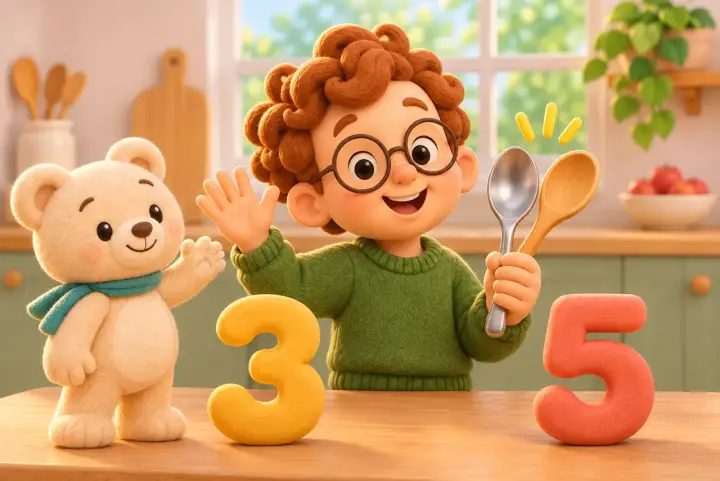
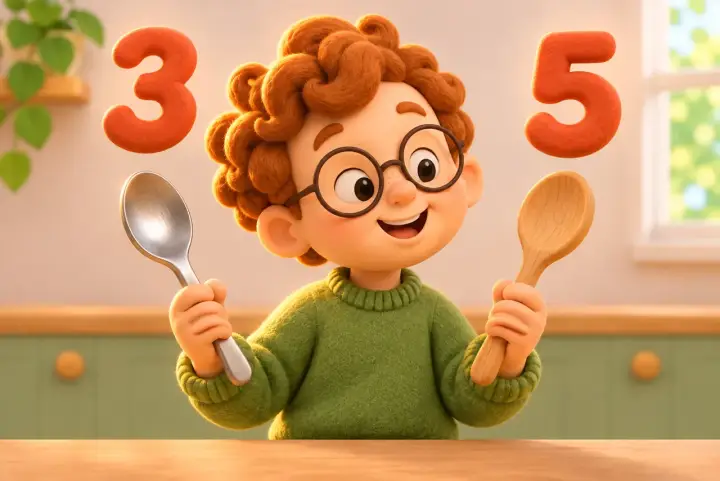
Every lesson comes with pictures, a short narrated-picture video and Listen read-aloud. Here are the pictures and Listen audio from one real lesson.
What is it made of?
Listen
Uma picks up a metal spoon and a wooden spoon. They look alike, but they feel different. What do you notice?
Grade 2 English language arts: units and lessons
Grade 2 English Language Arts
English language arts · 8 units · 130 lessons · about 69 hours
Aligned to 71 Common Core English language arts standards.
- Long and short vowels review (15 lessons). Long and short vowels in one-syllable words and vowel teams; asking and answering questions about stories.
- Sounds oi, oy, ou, aw, au (17 lessons). Diphthongs; how characters respond to challenges; rhythm and meaning in poems; narrative writing.
- Sounds oo, ew, ue and how-to texts (17 lessons). More vowel patterns; main topic and connections in nonfiction; informative writing.
- Soft c and g, tch, dge, ph (17 lessons). Tricky consonant spellings; word meanings and text features in nonfiction.
- Longer words and fluent reading (19 lessons). Two-syllable words, prefixes and suffixes; reading with accuracy and expression; opinion writing.
- Tales from many places (15 lessons). Folktales and fables from different cultures; comparing versions of the same story; retelling aloud.
- How things work (15 lessons). Diagrams, reasons and two texts on one topic; shared research and recording facts.
- Writer's workshop (15 lessons). Planning, revising and publishing our own writing, with digital tools and a final presentation.
Grade 2 math: units and lessons
Grade 2 Mathematics
Math · 9 units · 110 lessons · about 60 hours
Aligned to 28 Common Core math standards.
- Fluency within 20 and word problems (14 lessons). Mental strategies and one- and two-step problems.
- Place value to 1,000 (13 lessons). Hundreds, tens and ones; skip-counting; comparing three-digit numbers.
- Add and subtract within 100 (15 lessons). Strategies based on place value and properties; explaining why they work.
- Add and subtract within 1,000 (13 lessons). Models, drawings and place-value strategies with regrouping.
- Measuring length (11 lessons). Tools, units, estimating and comparing; length problems on number lines.
- Time and money (11 lessons). Time to five minutes; coins and bills.
- Data (11 lessons). Line plots, picture graphs and bar graphs.
- Equal groups and arrays (11 lessons). Odd and even; rectangular arrays as a bridge to multiplication.
- Shapes and fractions foundations (11 lessons). Attributes of shapes, partitioning rectangles, halves, thirds and fourths.
Grade 2 science: units and lessons
Grade 2 Science
Science · 6 units · 45 lessons · about 26 hours
Aligned to 11 Next Generation Science Standards (NGSS).
- Materials and their properties (8 lessons). Describing and testing materials for a purpose.
- Building and changing materials (8 lessons). Building from small pieces; heating and cooling changes.
- What plants need (8 lessons). Plants need water and light; how animals spread seeds and pollen.
- Habitats (7 lessons). Diversity of life in different habitats.
- Earth changes, fast and slow (8 lessons). Events that change land quickly or slowly; slowing wind and water erosion.
- Land and water (6 lessons). Mapping land and water; where water is found on Earth.
Grade 2 computing: units and lessons
Grade 2 Computing
Computing · 3 units · 30 lessons · about 17 hours
Aligned to 8 CSTA computer science standards.
- Plan and build a program (11 lessons). Planning, building and describing a program; giving credit for ideas.
- Animations and stories (10 lessons). Sequences, loops and events to tell a story.
- Digital citizens (9 lessons). Strong passwords, respectful collaboration and safe sharing.
Grade 2 engineering: units and lessons
Grade 2 Engineering
Engineering · 3 units · 10 lessons · about 7 hours
Aligned to 6 Next Generation Science Standards (NGSS).
- Seed spreaders (4 lessons). Designing a model that copies how animals spread seeds.
- Stop the erosion (3 lessons). Defining the problem and comparing ways to slow water or wind erosion.
- Build from small pieces (3 lessons). Taking apart and rebuilding an object into something new.
Free to use, not accredited
Lessons and practice are part of OptiAI's free Full Access. Only higher AI limits for parents are paid. OptiAI Core is our own curriculum, written to US standards. It is not accredited, and transcripts and report cards are issued by you, the parent.
The full plan for every grade is listed here. Lessons for the higher grades are still being added, and the app always shows what is ready for your child.