How lessons work
- Short lessons in a steady rhythm: a quick review, something new, practice, then a one-question check.
- Practice is marked as you go, with hints that arrive one tap at a time and never give the answer early.
- Lessons that were hard come back later for spaced review, so learning sticks.
- Kindergarten and Grade 1 lessons are read aloud, with songs and answers a child can say out loud.
- From Grade 2 up, lessons come with illustrations, a short lesson video and a Listen button that reads each step aloud.
- Parent reports show what was learned, what to revisit and the hours spent, and you keep the records.
Inside a lesson
Every lesson comes with pictures, a short narrated-picture video and Listen read-aloud. Here are the pictures and Listen audio from one real lesson.
Energy of motion

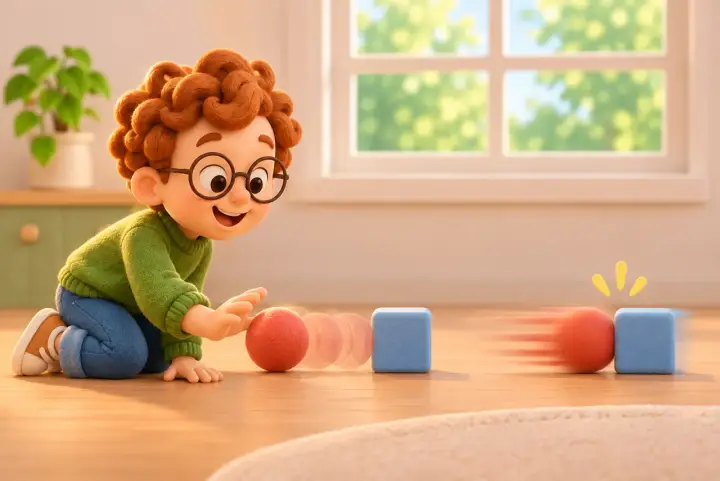
Listen
Liv rolls a ball slowly into a small block, then rolls it fast. Which roll will push the block farther?
Grade 4 English language arts: units and lessons
Grade 4 English Language Arts
English language arts · 8 units · 115 lessons · about 81 hours
Aligned to 87 Common Core English language arts standards.
- Stories and characters: heroes and helpers (16 lessons). Close reading of stories: details, theme and character; narrative writing.
- Reading to learn: Earth's changing surface (16 lessons). Main ideas, evidence and explanations in nonfiction; informative writing; word strategies.
- How authors write stories: myths and legends (14 lessons). Word choice, structure and point of view in stories; planning and revising writing.
- How nonfiction is built: inventions and inventors (14 lessons). Text structure and features in nonfiction; short research with notes and sources.
- Making a case: choices that matter (14 lessons). Opinion and argument: reasons, evidence and listening to other views.
- Poems, plays and pictures: poems and plays (14 lessons). Poetry, drama and visual media; comparing a text with its audio or film version.
- Texts in conversation: stories across cultures (14 lessons). Comparing texts on one theme or topic; presenting findings; writing with technology.
- Reading life and writing portfolio: my reading year (13 lessons). Independent reading at grade level, writing over time, and a portfolio of best work.
Grade 4 math: units and lessons
Grade 4 Mathematics
Math · 12 units · 120 lessons · about 86 hours
Aligned to 37 Common Core math standards.
- Place value to 1,000,000 (10 lessons). Reading, writing, comparing and rounding multi-digit numbers.
- Multi-digit addition and subtraction (8 lessons). The standard algorithm with understanding.
- Multiplicative comparison and factors (10 lessons). Times as many; factors, multiples, primes and composites.
- Multi-digit multiplication (11 lessons). Area models, partial products and properties.
- Division with remainders (11 lessons). Place-value strategies and interpreting remainders.
- Equivalent fractions (11 lessons). Generating and comparing equivalent fractions.
- Adding and subtracting fractions (12 lessons). Like denominators, mixed numbers and word problems.
- Multiplying fractions by whole numbers (10 lessons). Fractions as multiples of unit fractions.
- Decimal fractions (10 lessons). Tenths, hundredths and comparing decimals.
- Measurement and data (10 lessons). Converting units; area and perimeter formulas; line plots with fractions.
- Angles, lines and symmetry (11 lessons). Measuring and adding angles; lines, angles and line symmetry.
- Patterns (6 lessons). Generating and analysing number and shape patterns.
Grade 4 science: units and lessons
Grade 4 Science
Science · 7 units · 45 lessons · about 34 hours
Aligned to 14 Next Generation Science Standards (NGSS).
- Energy and speed (7 lessons). Speed and energy; energy changes in collisions.
- Energy transfer (7 lessons). Energy moves by sound, light, heat and electric currents.
- Waves and information (7 lessons). Wave patterns and sending information with patterns.
- Light and seeing (7 lessons). Light reflecting into the eye; how senses send information.
- Structures for survival (5 lessons). Internal and external structures of plants and animals.
- Earth's changing surface (6 lessons). Rock layers, weathering, erosion and map patterns.
- Energy resources and hazards (6 lessons). Renewable and non-renewable resources; reducing natural hazard impacts.
Grade 4 computing: units and lessons
Grade 4 Computing
Computing · 4 units · 30 lessons · about 22 hours
Aligned to 8 CSTA computer science standards.
- Variables and events (9 lessons). Storing and changing data in programs.
- Decompose and reuse (9 lessons). Breaking problems down and modifying existing programs.
- Networks and the internet (7 lessons). How information travels; troubleshooting.
- Technology and society (5 lessons). Diverse needs and the impact of computing.
Grade 4 engineering: units and lessons
Grade 4 Engineering
Engineering · 3 units · 10 lessons · about 8 hours
Aligned to 6 Next Generation Science Standards (NGSS).
- Energy converters (4 lessons). Designing a device that converts energy from one form to another.
- Coded signals (3 lessons). Comparing ways to send a coded message over a distance.
- Hazard helpers (3 lessons). Testing solutions that reduce the impact of a natural hazard.
Free to use, not accredited
Lessons and practice are part of OptiAI's free Full Access. Only higher AI limits for parents are paid. OptiAI Core is our own curriculum, written to US standards. It is not accredited, and transcripts and report cards are issued by you, the parent.
The full plan for every grade is listed here. Lessons for the higher grades are still being added, and the app always shows what is ready for your child.