How lessons work
- Short lessons in a steady rhythm: a quick review, something new, practice, then a one-question check.
- Practice is marked as you go, with hints that arrive one tap at a time and never give the answer early.
- Lessons that were hard come back later for spaced review, so learning sticks.
- Kindergarten and Grade 1 lessons are read aloud, with songs and answers a child can say out loud.
- From Grade 2 up, lessons come with illustrations, a short lesson video and a Listen button that reads each step aloud.
- Parent reports show what was learned, what to revisit and the hours spent, and you keep the records.
Inside a lesson
Every lesson comes with pictures, a short narrated-picture video and Listen read-aloud. Here are the pictures and Listen audio from one real lesson.
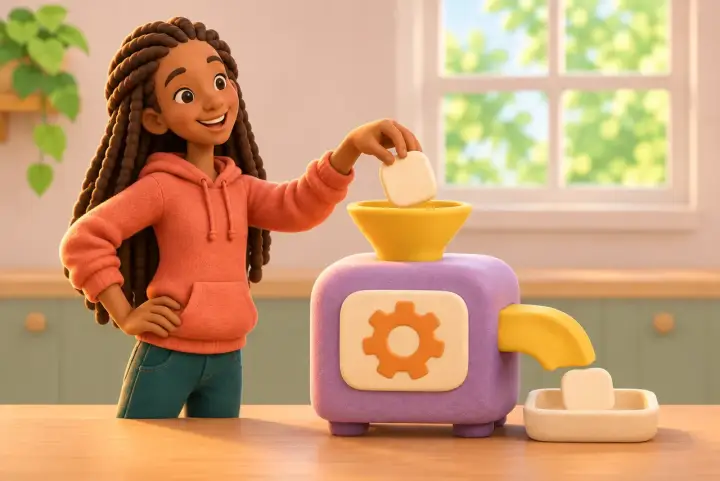
Function machines in a chain

Listen
You already know how to put a number into one rule and get an answer. What happens when that answer goes straight into a second rule?
Grade 12 English language arts: units and lessons
English 12
English language arts · 10 units · 150 lessons · about 135 hours · 1 credit
Aligned to 113 Common Core English language arts standards.
- Complex characters and the human condition (16 lessons). Characters, themes and ambiguity in British and world literature; narrative and reflective writing.
- British and world literature (15 lessons). Literature across centuries and continents; how authors transform earlier works; analytical writing.
- Style, nuance and the language of power (15 lessons). Connotation, irony and style in demanding texts; vocabulary for college reading.
- Argument, evidence and fallacies (17 lessons). Evaluating and building complex arguments; seminal texts and how they reason; writing a longer argument.
- Structure and point of view in complex texts (15 lessons). Structure, unreliable narrators and cultural perspective; revising for coherence and impact.
- Drama and poetry (15 lessons). Shakespeare, modern drama and poetry; interpreting stage and film choices; spoken delivery.
- Documents, history and public life (14 lessons). Historical and civic documents; comparing sources and weighing their reasoning.
- Science, technical and professional writing (14 lessons). Dense technical texts, data and procedures; writing for work and college.
- Capstone research paper (17 lessons). A capstone research paper with synthesis of many sources, citation and a media presentation.
- Portfolio and presentation (12 lessons). A final portfolio and presentation that shows growth across four years of English.
Grade 12 math: units and lessons
Precalculus
Math · 11 units · 150 lessons · about 136 hours · 1 credit
Aligned to 45 Common Core math standards.
- Composition and inverse functions (15 lessons). Composing functions, invertibility and inverses from graphs and tables; logarithms as inverses.
- Rational functions (13 lessons). Graphs, asymptotes and end behaviour of rational functions.
- The unit circle and trigonometric graphs (16 lessons). Special triangles, symmetry, inverse trigonometric functions and modelling.
- Trigonometric identities (13 lessons). Addition and subtraction formulas and solving trigonometric equations.
- Complex numbers in the plane (13 lessons). Rectangular and polar form, operations and distance in the complex plane.
- Vectors (15 lessons). Vector quantities, components and operations.
- Matrices and systems (14 lessons). Matrix operations, transformations and solving systems with inverses.
- Conic sections and solids (13 lessons). Ellipses and hyperbolas; Cavalieri's principle.
- Polar and parametric representations (13 lessons). Polar coordinates and graphs; parametric equations for motion.
- Sequences, series and limits (14 lessons). Arithmetic and geometric series, sigma notation, and the idea of a limit.
- Expected value and decisions (11 lessons). Random variables, expected value and weighing decisions.
Grade 12 science: units and lessons
Physics
Science · 9 units · 150 lessons · about 134 hours · 1 credit
Aligned to 21 Next Generation Science Standards (NGSS).
- Motion and Newton's laws (21 lessons). Describing motion and the second law.
- Momentum and collisions (17 lessons). Conservation of momentum and designing to reduce collision forces.
- Gravity and electric forces (16 lessons). Newton's law of gravitation, Coulomb's law and orbits.
- Electromagnetism (16 lessons). Currents and magnetic fields; fields storing energy.
- Energy conservation (20 lessons). Modelling energy in systems and designing energy converters.
- Thermal energy (12 lessons). Heat transfer toward equilibrium and the second law.
- Waves (16 lessons). Frequency, wavelength and speed; wave and particle models of light.
- Waves and information technology (16 lessons). Digital information, electromagnetic radiation and technology.
- Stars and the universe (16 lessons). Fusion in the sun, stellar life cycles and the Big Bang.
Grade 12 computing: units and lessons
Computer Science Principles
Computing · 10 units · 150 lessons · about 135 hours · 1 credit
Aligned to 30 CSTA computer science standards.
- Computing systems (13 lessons). Abstraction in hardware and software and troubleshooting.
- Python foundations (19 lessons). Variables, conditionals, loops and readable code.
- Representing data (13 lessons). Bits, encodings, compression and choosing representations.
- Lists and procedures (17 lessons). Data structures, procedures and libraries.
- Data and models (15 lessons). Visualising data and creating computational models.
- The internet (13 lessons). Protocols, addressing and how the internet scales.
- Cybersecurity (13 lessons). Threats, safeguards and encryption.
- Software development process (16 lessons). Iterative design, team roles, testing and documentation.
- Impact of computing (16 lessons). Society, careers, accessibility, law, ethics and bias.
- Create project (15 lessons). A personal Python project from plan to tested program and written reflection.
Free to use, not accredited
Lessons and practice are part of OptiAI's free Full Access. Only higher AI limits for parents are paid. OptiAI Core is our own curriculum, written to US standards. It is not accredited, and transcripts and report cards are issued by you, the parent.
The full plan for every grade is listed here. Lessons for the higher grades are still being added, and the app always shows what is ready for your child.