How lessons work
- Short lessons in a steady rhythm: a quick review, something new, practice, then a one-question check.
- Practice is marked as you go, with hints that arrive one tap at a time and never give the answer early.
- Lessons that were hard come back later for spaced review, so learning sticks.
- Kindergarten and Grade 1 lessons are read aloud, with songs and answers a child can say out loud.
- From Grade 2 up, lessons come with illustrations, a short lesson video and a Listen button that reads each step aloud.
- Parent reports show what was learned, what to revisit and the hours spent, and you keep the records.
Inside a lesson
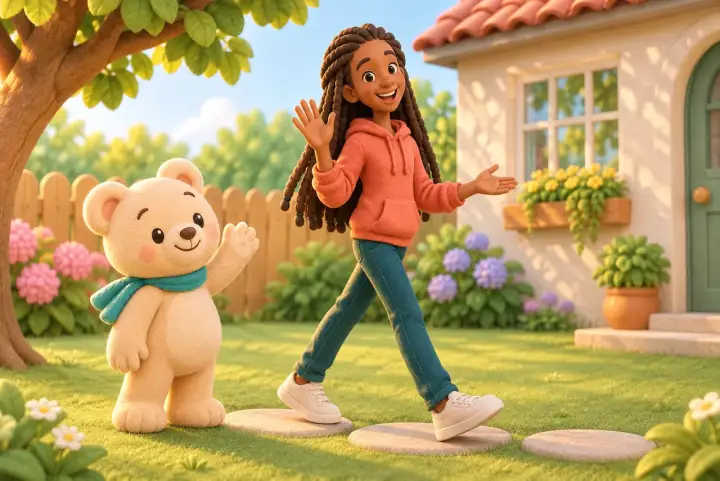
Every lesson comes with pictures, a short narrated-picture video and Listen read-aloud. Here are the pictures and Listen audio from one real lesson.
Describing motion: position and distance

Listen
Amara walks across the yard and tries to say exactly where she is. How could she describe her spot so a friend could find it?
Grade 11 English language arts: units and lessons
English 11
English language arts · 10 units · 150 lessons · about 135 hours · 1 credit
Aligned to 113 Common Core English language arts standards.
- American voices: character and theme (16 lessons). Characters and themes in American novels and stories across periods; narrative and reflective writing.
- Argument and rhetoric in American texts (17 lessons). Reasoning, rhetoric and evidence in speeches and essays; writing a sustained argument.
- American literature across periods (15 lessons). Colonial to contemporary writers and how they respond to one another; analytical writing.
- Language, style and meaning (15 lessons). Nuance, tone and the effect of word choice; refining style and precision.
- Structure and perspective (15 lessons). Structure, point of view and satire; how choices create meaning; drafting and revising.
- Foundational US documents (15 lessons). Founding documents, landmark decisions and speeches; reading closely for reasoning and purpose.
- Drama and poetry (14 lessons). American drama and poetry; interpreting performances and speaking with evidence.
- Research paper (17 lessons). A sustained research project: inquiry, synthesis, citation and a presentation with media.
- Science and technical reading and writing (14 lessons). Technical and scientific texts, data and argument; writing for professional audiences.
- Portfolio and presentation (12 lessons). Revising best work into a portfolio and presenting it; reflection and next steps.
Grade 11 math: units and lessons
Algebra 2
Math · 10 units · 150 lessons · about 135 hours · 1 credit
Aligned to 55 Common Core math standards.
- Function families and transformations (16 lessons). Key features, transformations and building new functions.
- Complex numbers and polynomial arithmetic (14 lessons). The complex number system and operations with polynomials.
- Polynomial functions (17 lessons). Remainder theorem, zeros, identities and graphs.
- Rational expressions and equations (16 lessons). Rewriting rational expressions; solving and explaining extraneous solutions.
- Radical functions and inverses (14 lessons). Square and cube root functions; finding inverses.
- Exponential and logarithmic functions (19 lessons). Logarithms as inverses, solving exponential equations, and finite geometric series.
- Trigonometric functions (17 lessons). Radian measure, the unit circle, periodic models and the Pythagorean identity.
- Modelling with functions (11 lessons). Choosing and combining function models for real data.
- Statistics and inference (17 lessons). Normal distributions, sampling, surveys, experiments and margin of error.
- Probability for decisions (9 lessons). Fair decisions and analysing decisions with probability.
Precalculus
Math · 11 units · 150 lessons · about 136 hours · 1 credit
Aligned to 45 Common Core math standards.
- Composition and inverse functions (15 lessons). Composing functions, invertibility and inverses from graphs and tables; logarithms as inverses.
- Rational functions (13 lessons). Graphs, asymptotes and end behaviour of rational functions.
- The unit circle and trigonometric graphs (16 lessons). Special triangles, symmetry, inverse trigonometric functions and modelling.
- Trigonometric identities (13 lessons). Addition and subtraction formulas and solving trigonometric equations.
- Complex numbers in the plane (13 lessons). Rectangular and polar form, operations and distance in the complex plane.
- Vectors (15 lessons). Vector quantities, components and operations.
- Matrices and systems (14 lessons). Matrix operations, transformations and solving systems with inverses.
- Conic sections and solids (13 lessons). Ellipses and hyperbolas; Cavalieri's principle.
- Polar and parametric representations (13 lessons). Polar coordinates and graphs; parametric equations for motion.
- Sequences, series and limits (14 lessons). Arithmetic and geometric series, sigma notation, and the idea of a limit.
- Expected value and decisions (11 lessons). Random variables, expected value and weighing decisions.
Grade 11 science: units and lessons
Chemistry
Science · 8 units · 150 lessons · about 133 hours · 1 credit
Aligned to 17 Next Generation Science Standards (NGSS).
- Atoms and the periodic table (18 lessons). Atomic structure, electron patterns and periodic trends.
- Bonding and forces between particles (18 lessons). Bulk properties, intermolecular forces and designed materials.
- Chemical reactions (23 lessons). Predicting products, balancing equations and conservation of atoms.
- Energy in reactions (18 lessons). Bond energy, exothermic and endothermic changes.
- Rates and equilibrium (21 lessons). Collision theory, rates, equilibrium shifts and optimising a reaction design.
- Nuclear processes (18 lessons). Fission, fusion, radioactive decay and dating rocks.
- Earth's materials and water (17 lessons). Earth's internal processes, the properties of water and plate tectonics.
- Chemistry of climate and resources (17 lessons). Carbon cycling chemistry and the costs and benefits of energy resources.
Physics
Science · 9 units · 150 lessons · about 134 hours · 1 credit
Aligned to 21 Next Generation Science Standards (NGSS).
- Motion and Newton's laws (21 lessons). Describing motion and the second law.
- Momentum and collisions (17 lessons). Conservation of momentum and designing to reduce collision forces.
- Gravity and electric forces (16 lessons). Newton's law of gravitation, Coulomb's law and orbits.
- Electromagnetism (16 lessons). Currents and magnetic fields; fields storing energy.
- Energy conservation (20 lessons). Modelling energy in systems and designing energy converters.
- Thermal energy (12 lessons). Heat transfer toward equilibrium and the second law.
- Waves (16 lessons). Frequency, wavelength and speed; wave and particle models of light.
- Waves and information technology (16 lessons). Digital information, electromagnetic radiation and technology.
- Stars and the universe (16 lessons). Fusion in the sun, stellar life cycles and the Big Bang.
Grade 11 computing: units and lessons
Computer Science Principles
Computing · 10 units · 150 lessons · about 135 hours · 1 credit
Aligned to 30 CSTA computer science standards.
- Computing systems (13 lessons). Abstraction in hardware and software and troubleshooting.
- Python foundations (19 lessons). Variables, conditionals, loops and readable code.
- Representing data (13 lessons). Bits, encodings, compression and choosing representations.
- Lists and procedures (17 lessons). Data structures, procedures and libraries.
- Data and models (15 lessons). Visualising data and creating computational models.
- The internet (13 lessons). Protocols, addressing and how the internet scales.
- Cybersecurity (13 lessons). Threats, safeguards and encryption.
- Software development process (16 lessons). Iterative design, team roles, testing and documentation.
- Impact of computing (16 lessons). Society, careers, accessibility, law, ethics and bias.
- Create project (15 lessons). A personal Python project from plan to tested program and written reflection.
Free to use, not accredited
Lessons and practice are part of OptiAI's free Full Access. Only higher AI limits for parents are paid. OptiAI Core is our own curriculum, written to US standards. It is not accredited, and transcripts and report cards are issued by you, the parent.
The full plan for every grade is listed here. Lessons for the higher grades are still being added, and the app always shows what is ready for your child.